During Holy Week, you probably participated in the Stations of the Cross or saw others from your community doing so. But what exactly are the Stations of the Cross?
This prayerful tradition not only allows us to get a better glimpse of Jesus’ passion but allows us to enter an interactive prayer that brings us closer to God. By learning the importance of each station and how best to practice Stations of the Cross you can get more out of the prayerful devotion.
The 14 Stations of the Cross
The Church has universally recognized these 14 stations since the 18th century.
1. Jesus is Condemned to Death
Pontius Pilate condemns Jesus to death. Jesus submits to his unjust punishment to save humanity from original sin.
2. Jesus Carries the Cross
Jesus, sentenced to crucifixion, is forced to carry the wooden cross that will become the instrument for his death.
3. Jesus Falls the First Time
Due to the heavy weight of this wooden cross, Jesus collapses. However, he is forced by the guards to get up and continue his painful journey.
4. Jesus Meets his Mother
Jesus’ mother Mary is on the road leading to Jesus’ crucifixion. They see each other and recognize the sorrow of this moment.
5. Simon Helps Jesus Carry His Cross
Simon of Cyrene is forced by Roman soldiers to help Jesus carry his Cross. We should similarly help others with their burdens.
6. Veronica Wipes the Face of Jesus
A holy woman steps out from the crowd to wipe the blood and sweat from Jesus’ forehead. His Holy Face is imprinted on her veil.
7. Jesus Falls a Second Time
Although Simon is helping Jesus carry his cross, he still struggles under its extreme weight and falls a second time.
8. Jesus Meets the Women of Jerusalem
On his path Jesus meets women who weep for him and his sorrowful passion. Jesus instructs them not to worry, but care for themselves and their children.
9. Jesus Falls a Third Time
As Jesus nears the top of Calvary, the destination of his death, he falls a third time.
10. Jesus is Stripped of His Garments
Roman soldiers take Jesus’ clothing, his only remaining physical possession. The soldiers proceed to gamble for his clothes.
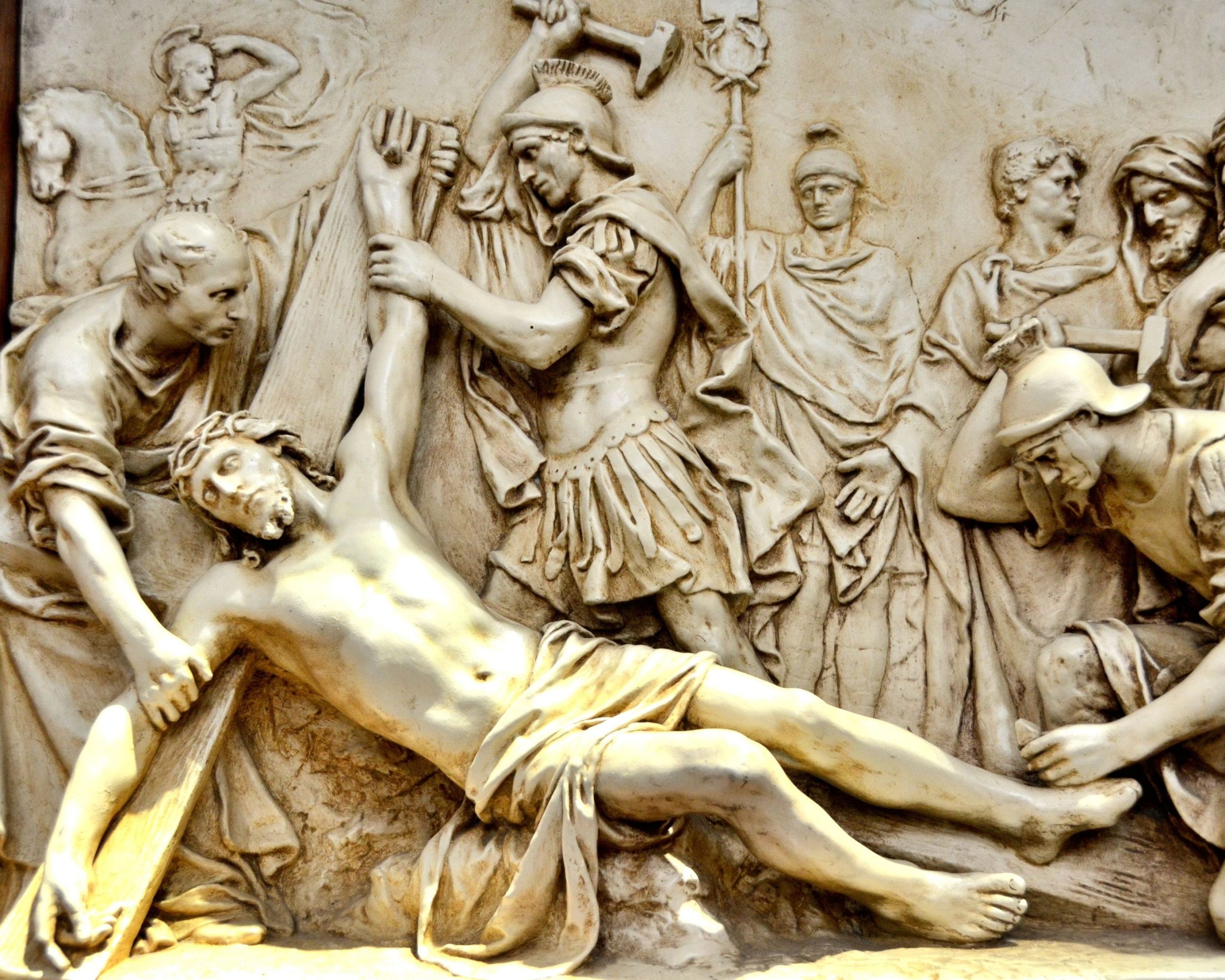
11. Jesus is Nailed to the Cross
Jesus is placed upon the cross and nails are driven through his palms and his feet.
12. Jesus Dies on the Cross
After three hours of struggling in agony, Jesus bows His head and allows his spirit to return to the Father.
13. Jesus is Taken Down from the Cross
Jesus is removed from the cross and given to his grieving mother.
14. Jesus is Laid in the Tomb
Joseph of Arimathea wraps Jesus in a clean linen shroud and places him within his tomb
Praying the Stations of the Cross
This devotion consists of two main actions: movement and meditation. You physically walk through the stations and consider the movement Jesus made towards his painful death. Simultaneously you meditate on his passion and consider the importance of Jesus’ sacrifice.
Movement:
Move through the stations: go through each station in numerical order. Physically walk to the image or statue depicting the scene and study the art portraying the passion.
Genuflect: Kneel when you arrive at the station. If you would like to pray aloud it’s common to say, “We adore you O Christ and we praise you, because by your holy cross you have redeemed the world.”
Meditation:
Meditate: Study the image before you and consider the power of what it is depicted. Close your eyes and think of what you have just seen. What wonder it is that Jesus suffered and died on the cross to absolve our original sin.
Pray: Recite a prayer of your choice. Our Father, Hail Mary, or Glory Be are common. You can also find specific mediation guides at many churches.
The Stations of the Cross are a powerful way to consider and meditate on Jesus’ sacrifice. It’s not just something you can do during Holy Week, however. Consider taking the time to move through and meditate on the Stations of the Cross.
As St. Bonaventure once said, “There is no practice more profitable for the entire sanctification of the soul than the frequent meditation of the sufferings of Jesus Christ.”
Safeguarding Statement
The Franciscan Friars Conventual of St. Bonaventure Province are committed to creating safe environments for children and vulnerable adults.
Every friar in active ministry must complete training in Virtus (the National Catholic Risk Retention Group) and any other safe environment compliances required by the dioceses in which they serve.
In addition, St. Bonaventure Province has its own Safe Environment Commission that oversees the implementation and monitoring of the Province’s Policies, Procedures, and Protocols for Ethical Ministry with Minors and Vulnerable Adults.
Any allegation regarding the Franciscan Friars Conventual of this Province receives an immediate response. This includes the Province’s full cooperation with local law enforcement authorities and Ordinaries who have ecclesial jurisdiction over these matters, as well as a duly diligent investigation by a qualified third party in order to substantiate credibility.